
- Sponsored Content -
Continence health conditions affect a large portion of Europe’s population, with impacts at both the personal and societal level. Although urinary incontinence is very common, it remains an undertreated condition. During World Continence Week, we discussed minimally invasive treatment options for urinary incontinence with Miguel Aragon, vice president and general manager of Urology, Capital & Services in the Europe, Middle East and Africa (EMEA) region at Boston Scientific.

How did Boston Scientific’s acquisition of Axonics help the company to address this healthcare challenge?
Boston Scientific focuses on delivering minimally invasive treatment options that address unmet clinical needs and help improve patient outcomes.
Specifically in the management of urinary incontinence, the acquisition of Axonics, Inc. expanded our Urology portfolio to include the Axonics™ Sacral Neuromodulation (SNM) Systems to treat overactive bladder (OAB) in men and women as well as the Bulkamid™ Urethral Bulking System for the treatment of stress urinary incontinence (SUI) in women. The addition of these therapies to our portfolio allows us to better address the needs of patient populations who are currently underserved.
What does the full Boston Scientific Urology portfolio include?
Both the SNM systems and the urethral bulking agent are complementary to our existing Urology portfolio for urinary incontinence in EMEA, which also includes mid-urethral slings and an artificial urinary sphincter. Together, they expand our category leadership and give us the ability to address a broader range of incontinence conditions. Our wider Urology portfolio also includes solutions to support the treatment of kidney stones, benign prostatic hyperplasia, prostate cancer and erectile dysfunction.
You mentioned OAB and SUI - can you talk more about these conditions and their impact?
Overactive bladder with incontinence is characterised by a frequent, sudden and intense need to urinate, resulting in unintentional urine loss. The sacral nerves, located near the tailbone, control the bladder and muscles related to urinary function. If the brain and sacral nerves do not communicate correctly, bladder control may be affected. OAB affects almost 50 million people in Europe. In the United Kingdom, approximately 4.5 million people are living with OAB, a number which is projected to rise to over seven million by 2035 due to an ageing population. OAB is associated with several risk factors, including diabetes, and childbirth.
Stress urinary incontinence involves the involuntary loss of urine during physical activities such as laughing, jumping, sneezing or lifting heavy objects. This can be related to weakness in the pelvic floor muscles or urethral support. Potential causes include pregnancy, childbirth, menopause and ageing. It is estimated that one in three women may experience SUI at some point in their lives [1].
Both conditions can affect daily routines and participation in everyday activities as well as a person’s confidence and overall quality of life.
At a societal level, the economic burden in the European Union is estimated to have reached approximately 70 billion Euro in 2023, including healthcare costs, productivity loss and environmental impact [2].
What sacral neuromodulation innovations does Boston Scientific offer?
At Boston Scientific, our purpose is Advancing Science for Life. This means developing meaningful innovations that support patients so that they can enjoy more of what matters most to them.
In this respect, we offer two SNM devices to treat OAB, providing both long-term battery life and lasting symptom relief. The rechargeable Axonics R20™ device is designed to last at least 20 years and only requires a recharge every six to ten months, while the Axonics F15™ implant is the longest-lasting recharge-free SNM device currently on the market, with a battery life ranging from 10 to 20 years.
Meaningful innovation is also about expanding access so more patients may benefit from the technologies. For example, we received EU-MDR approval for the faecal incontinence indication for the Axonics R20 SNM System.
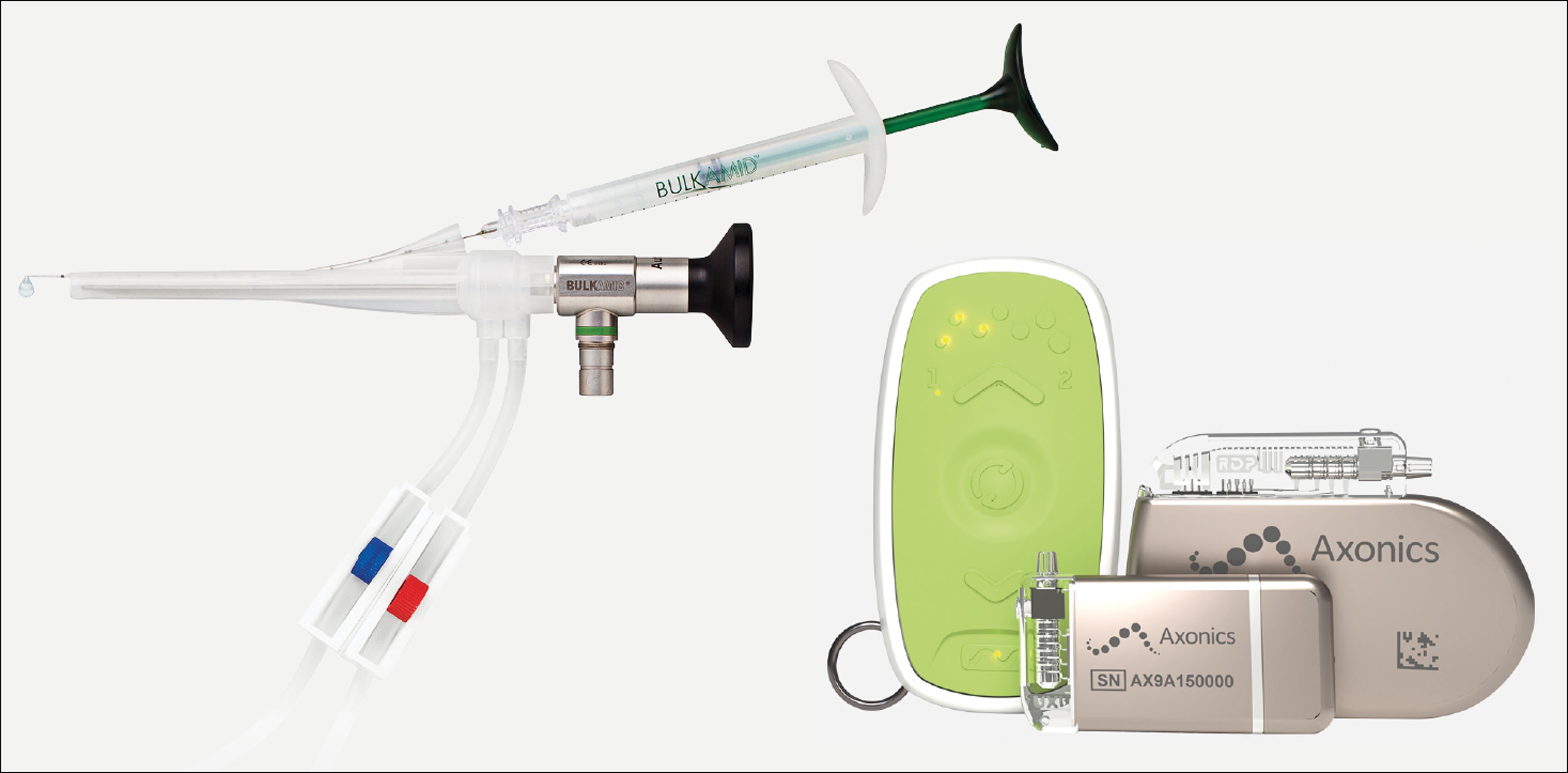
The Bulkamid™ Urethral Bulking System and the Axonics F15™ and R20™ Sacral Neuromodulation (SNM) Systems.
What makes the Axonics SNM Systems an innovative option for patients?
Beyond battery longevity, the system is designed to support ease of use. For example, both devices can be managed with a pocket-size remote control and do not require additional communicators, which may help simplify therapy management for patients. In addition, an interchangeable tined lead compatible with both devices allows patients to switch between rechargeable and recharge-free therapy, offering flexibility over time.
Both technologies are minimally invasive and are designed to support MRI access under specified conditions.
Together, these technologies provide flexibility to meet individual patient needs and support long-term therapy management so that patients can focus on their life, rather than on their device.
Why is providing patients with multiple choices important?
Every patient is different, and urological conditions might evolve over time. Treatment decisions should reflect a person’s stage of life, preferences and overall clinical profile. It is important for patients to discuss all options, including their risks, in depth with their doctor.
For instance, offering a choice between rechargeable and recharge-free sacral neuromodulation devices means that people can select what best suits their needs and lifestyle. Also, the therapy includes a trial phase, allowing patients to test the system before proceeding with the full implant.
How do the Axonics SNM Systems deliver meaningful innovation for clinicians?
The interchangeable tined leads support flexibility in clinical decision-making, while a smart programming algorithm enables them to personalise patient care, as they receive program recommendations based on intra-operative responses and lead placement.
What is the broader impact of urinary incontinence on UK patients, and why is awareness important?
There remains a level of stigma around urinary incontinence, so people with urinary incontinence may limit social engagement and experience feelings of shame and isolation. Data from the European survey ‘Breaking the Silence’ suggests that around 70% of Europeans living with urinary incontinence report a negative impact on their lives. The burden extends across physical, mental, social and economic dimensions with embarrassment, shame and worry identified as primary psychological barriers. It is therefore important to raise awareness among the wider population that urinary incontinence is often manageable and that people should not feel that “it is simply part of ageing.”
Solutions that can bring lasting relief and offer a clinically proven approach exist. Yet currently only a small minority of eligible patients get access to advanced therapies.
Supporting awareness and informed decision making is an important step in improving patient care.
References
1. Magon N, Kalra B, Malik S, Chauhan M. Stress urinary incontinence: What, when, why, and then what? J Midlife Health. 2011;2(2):57–64.
2. European Association of Urology (EAU). An urge to act. Available at: https://uroweb.org/an-urge-to-act (accessed April 2026).
Sponsored by

 797 & 0123
URO-2483208-AA
CAUTION: The law restricts these devices to sale by or on the order of a physician. Indications, contraindications, warnings, and instructions for use can be found in the product labelling supplied with each device. Products shown for INFORMATION purposes only and may not be approved or for sale in certain countries. This material not intended for use in France.


