With competition ratios for core surgical training (CST) rising to 9 to 1, career progression and job security are an ever-increasing stress for resident doctors [1]. Of the 630 jobs available in 2025, only a small fraction of these will be urology themed.
Themed posts are more competitive as they provide greater exposure to the specified surgical specialty. For example, my urology theme CST post provides 18 months of urology experience, which is extremely advantageous for building a urology ST3 application.
So, what makes you a successful CST applicant?
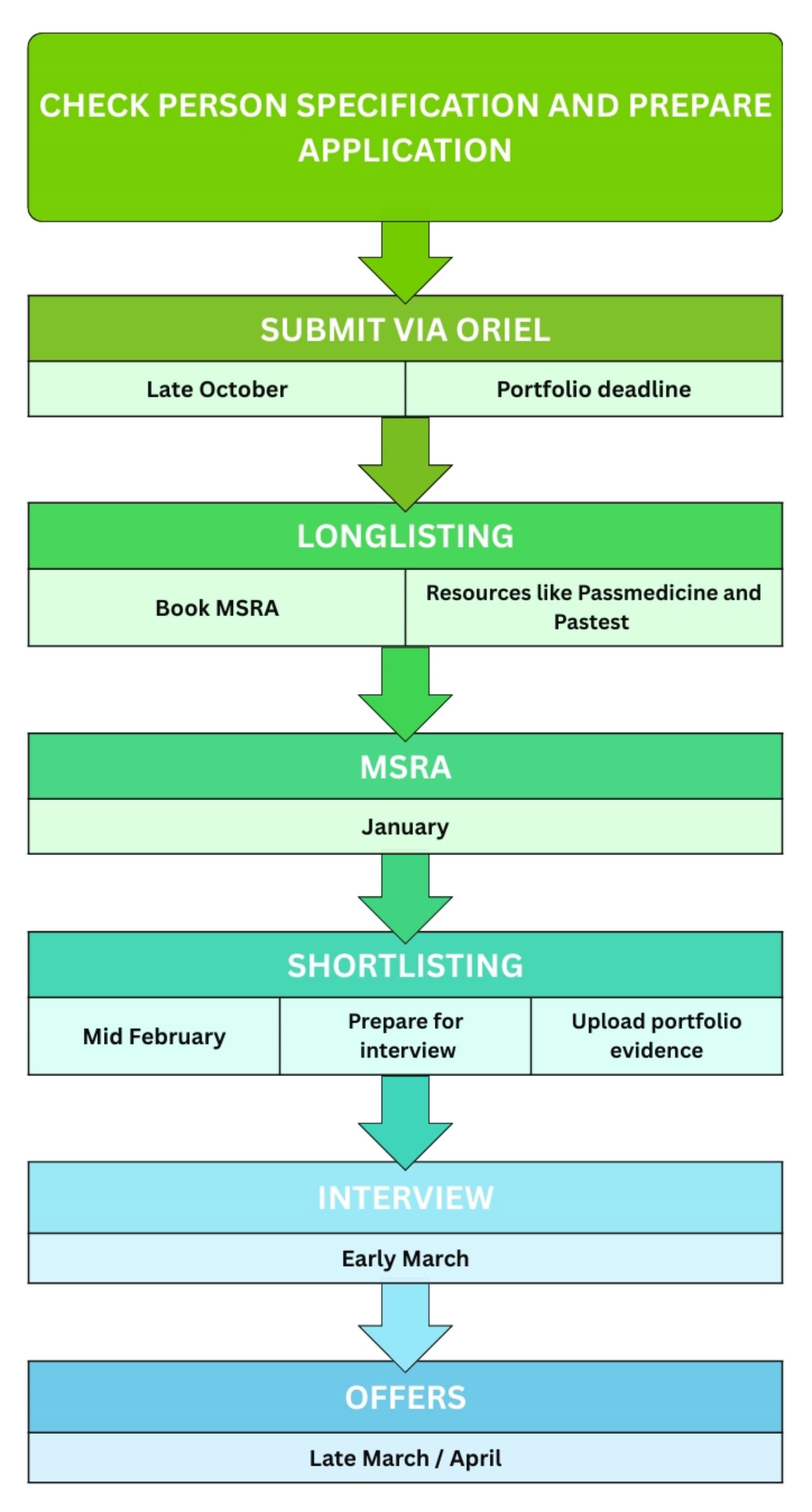
Aside from the eligibility criteria laid out by Health Education England (HEE), there are three components to a CST application: the Multi-Specialty Recruitment Assessment (MSRA), the portfolio and the interview [2]. To be not just a successful candidate but a competitive one, planning and careful reading of the published requirements are key.
The applications open in late October and remain open for around one month. All eligible candidates will then be invited to sit the MSRA in early January. Based on your score from this exam, you may be invited to interview. You will then be ranked nationally based on your MSRA score, portfolio and interview score. It is this ranking which determines if you successfully get a CST place and which CST post you get.
The MSRA
The MSRA was first implemented for CST during the 2023 recruitment cycle and now acts as a shortlisting tool for the massive pool of candidates applying. The exam is split into two papers, both of which are multiple-choice. The clinical problem-solving paper is arguably where revision can make the most difference. Popular resources include the Passmedicine and Pastest MSRA question banks, and most people start revising a few months before the exam. A little and often approach is the best way to avoid burnout – downloading the question bank apps onto your mobile allows you to fit in quick revision sessions throughout the day.
The professional dilemmas paper is somewhat more difficult to revise, with commercial question banks offering contradictory answers. It is better to rely on the official papers provided by Health Education England or revisit the preparation materials provided by the UK Foundation Programme [3,4].
The interview
If you score highly enough in the MSRA, you will be invited to interview. The format is ever-changing, but the underlying principles remain the same: clinical knowledge, professional integrity, probity and good communication skills [5]. The interview panel will have set questions to ask, answer them concisely so you can show your knowledge whilst allowing them to finish. Most important to remember during the interview is that they are not expecting detailed knowledge of niche clinical scenarios; they are assessing whether you practice safely. Saying you would speak to a senior does not mean you fail that station.
Newly introduced in 2025 is the involvement of the portfolio within the interview. Confidence in your presentation skills is fundamental here. You have a limited amount of time to show the panel that you are committed to urology, have taken part in audit and research, and are a capable teacher. Practising your answers with your colleagues is a valuable tool that can help you build your ability to answer clearly and concisely.
Resources such as Medibuddy and the ISC medical interviews book are often used by candidates and have a range of scenarios to practice.
The portfolio
The portfolio itself consists of four sections: commitment to specialty, quality improvement/clinical audit, presentations and publications, and finally, teaching experience.
Use the CST application as a chance to develop your urology ST3 portfolio; the requirements overlap, and ensuring that your work for CST aligns with the guidelines for ST3 will prevent you from having to repeat audits or rewrite pieces of evidence.
Commitment to specialty
Gain points here by organising a surgical taster week or a surgical elective. Use these opportunities to build your surgical logbook, and make sure you record every procedure you have been a part of.
Quality improvement and clinical audit
Closed-loop audits are consistently a high-value tool for gaining portfolio points, both for CST and ST3. Fitting them into a four-month foundation rotation can seem difficult, so speak to colleagues who have worked in the department beforehand to develop an idea before you begin your post. That means you can hit the ground running. The audit does not need to be complex but does need to be closed-loop for maximum CST points and urology-themed for maximum ST3 points.
Presentations and publications
Perhaps the most daunting of all the sections, but a key part of continuing professional development. The British Association of Urological Surgeons hold multiple conferences each year, which serve as a great opportunity to present your research. Watch out for the submission deadlines to ensure you don’t miss out.
If you have managed to get a publication before CST, that is a significant achievement worth showing off in your portfolio. If not, consider the effort and time needed for publications; there may be more value in focusing on other aspects of your portfolio, such as audits and QIPs, which are just as important but perhaps less time-consuming.
Teaching
Teaching is something that most of us are doing on a regular basis with medical students at the bedside or casually in the doctor’s office. Gaining feedback and reflecting on it helps to demonstrate your skills. Formalising and delivering a teaching programme is necessary for maximum points on the 2025/26 CST portfolio. It may seem laborious, but as something that will remain a key part of your portfolio beyond CST and into ST3, it is worth investing time in this aspect of your portfolio.
Common pitfalls
- If you take a year out between your foundation years and CST, remember that you cannot have more than 18 months experience in surgery outside your foundation posts.
- Build your portfolio before the close of applications – anything achieved following this will not be counted.
- Retrospective evidence gathering is a common way to lose points. Moving hospitals or losing contact with your supervising consultants can make it difficult to get your evidence signed off.
- Don’t rely on off days as opportunities to cram; you never know how difficult your prior shift might be. Starting preparation early and factoring in an hour each day over several months will prevent burnout.
How will the Medical Prioritisation Act affect CST applicants?
For CST offers made from 2027 onwards, the Medical Prioritisation Act means that certain groups of applicants will be prioritised for interview, and following this, job offers, before other eligible applicants [6].
Who are the prioritised groups for CST?
- UK medical graduates.
- Applicants who have a medical degree from Ireland, Iceland, Liechtenstein, Norway or Switzerland.
- Applicants who have completed or are currently completing the UK foundation programme.
- Applicants with significant experience working as a doctor in the NHS in the UK, although what significant experience means is yet to be defined.
- Applicants within specific priority groups based on immigration status, such as British citizens, Commonwealth citizens with the right of abode in the UK and Irish citizens who do not require leave to enter or remain in the UK, among others.
It may seem overwhelming and impossible to achieve, but most of the skills required are what you do every day anyway. Using the resources available to revise for the MSRA, practising your interview skills with your colleagues, and carefully reviewing the evidence they want for your portfolio are critical. There is a lot to manage, but preparation and consistency are the best strategies for developing your application and becoming a Core Surgical Trainee.
TAKE HOME MESSAGES
-
Little and often – fit revision and portfolio building around a busy job in short, regular bursts.
-
Professional integrity, probity and good communication skills are just as important as clinical knowledge.
-
Practice with your colleagues – they’re in the same boat as you.
-
Be tactical with your portfolio; try to map the requirements to the Urology ST3 self-assessment guide.
-
Organise a taster week and log all your surgical cases.
References
1. Competition ratios for 2025. NHS England 2025.
https://medical.hee.nhs.uk/medical-training
-recruitment/medical-specialty-training/competition
-ratios/2025-competition-ratios
2. Core Surgical Training CT1: Person specification and entry criteria for Core Surgical Training CT1 2026 recruitment. NHS England 2026.
https://medical.hee.nhs.uk/medical-training
-recruitment/medical-specialty-training/person
-specifications/person-specifications-2026/
core-surgical-training-ct1-2026
3. Professional Dilemmas paper: What’s in the MSRA? NHS England 2023.
https://medical.hee.nhs.uk/medical-training
-recruitment/medical-specialty-training/multi
-specialty-recruitment-assessment-msra/
whats-in-the-msra/professional-dilemmas-paper
4. Preparation Materials. UK Foundation Programme 2026.
https://foundationprogramme.nhs.uk/programmes/
f2-stand-alone/f2sa2025-sjt/preparation-materials/
5. Interviews: Core Surgery Training. NHS England 2025.
https://medical.hee.nhs.uk/medical-training
-recruitment/medical-specialty-training/surgery/
core-surgery/overview-of-core-surgery-training/interviews
6. Medical Training (Prioritisation) Act 2026 (c. 7). 2026.
www.legislation.gov.uk/ukpga/2026/7#section-2-2-a
[All links last accessed May 2026].
Declaration of competing interests: None declared.