In this series of articles I am going to show you some of the exhibits contained in the BAUS Virtual Museum of the History of Urology which is part of the BAUS website (www.baus.org.uk).
In the last article I said I would tell you to whom the British Government paid £5000 for a recipe to cure bladder stones. Well, the answer is Joanna Stephens in 1739; this was a fabulous amount of money at that time, the equivalent of £650,000 today.
The historical treatment of bladder stone was open lithotomy,an agonising and dangerous operation; thus, any non-surgical alternative to treat stones was eagerly sought. So, when in 1738 an article was published in the Gentleman's Magazine extolling the benefits of Mrs Stephens's Cure for the stone, national interest was generated. Joanna Stephens was the daughter of a "Gentleman of good estate and family in Berkshire''. It is unclear how she came to possess the recipe which consisted of a pill, a decoction* and a powder. Stephens offered the recipe to the country for £5000. At first a private subscription was set up through the Gentleman's Magazine and when this only raised £1356.3s, a petition was made to Parliament.
"Her remedy would have worked for some patients but, more importantly, it stimulated the pursuit of chemical analysis of stones which formed the basis of modern medical biochemistry"
A Parliamentary committee was set up and they agreed that the recipe should be tested on four stone sufferers. The patients were examined before and after by a committee of 22 doctors, politicians and scientists and found to be cured. Parliament agreed to pay Joanna Stephens £5000 and she published her recipe in the London Gazette on 16th June 1739. The powder consisted of egg shells and snails; the decoction boiled herbs, soap, swines' cresses and honey; and the pills, snails, wild carrot seeds, burdock seeds, ashen keys, hips, hawes, soap and honey.
This may not sound very appetising nor very scientific but some of the ingredients, notably the alka line soap, will dissolve urate stones.The remedy was scrupulously analysed and tested by scientists in England and France. Dr David Hartley (who himself had been cured of stone using it) published 155 cases of its successful use (Figure 1 ).
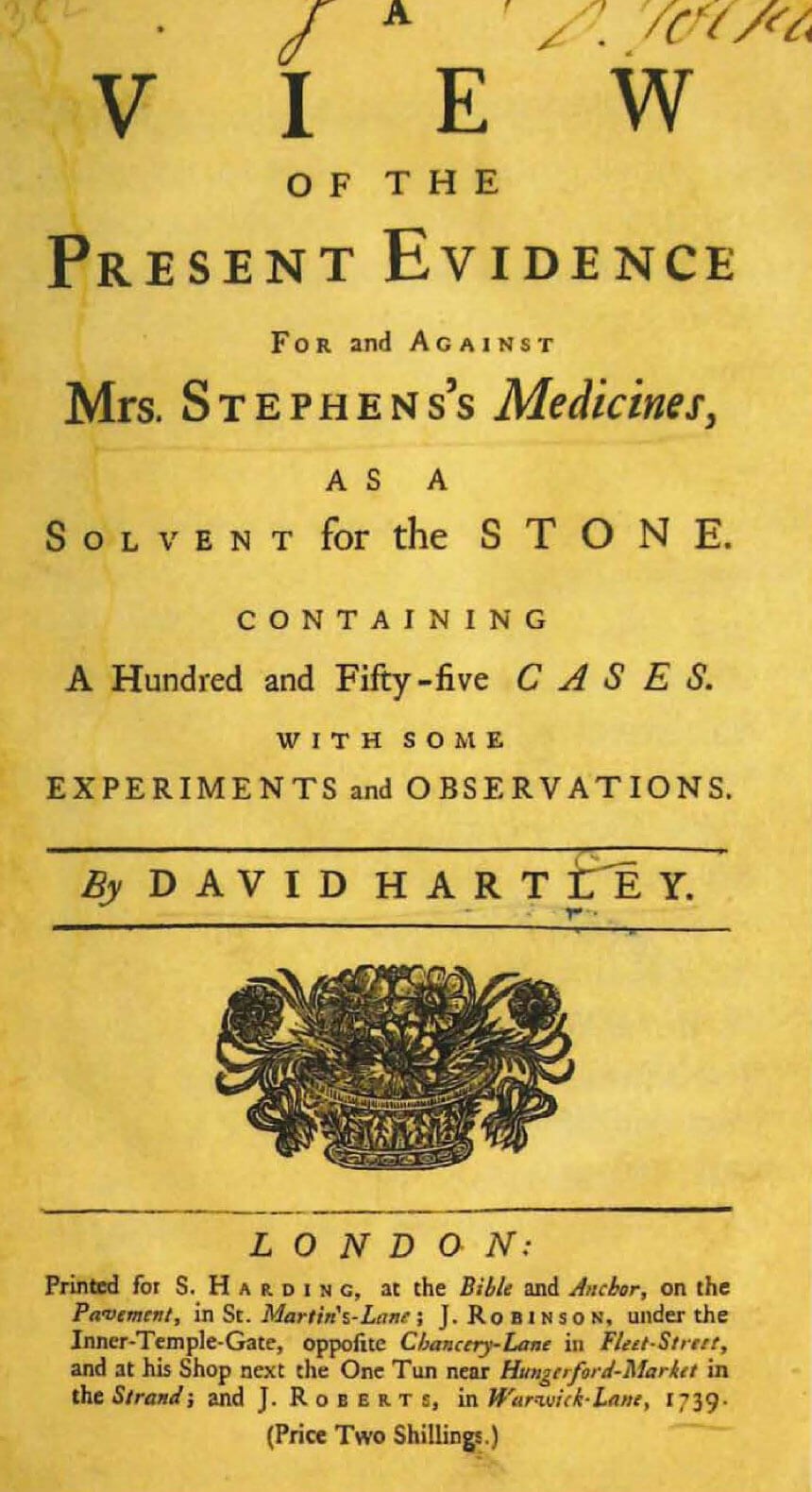
Figure 1: Frontispiece of David Hartley's review of Joanna Stephens's Medicines (1739).
Lithontriptics, medicine to dissolve stones in vivo, had been tried for thousands of years. As chemical knowledge and techniques progressed, more thought was put to their composition and actions. Alexander Marcet subsequently analysed stones and defined six types, lithic acid, oxalate of lime, cystine, ca lcium carbonate, phosphate of lime and ammonium magnesium phosphate.
Joanna Stephens has, by many, been relegated to the position of 18th Century quack, however it's clear that her remedy would have worked for some patients but, more importantly, it stimulated the pursuit of chemical ana lysis of stones which formed the basis of modern medical biochemistry.
Next time I will be telling you about Edwin Hurry Fenwick. He was portrayed as the senior surgeon in the BBC's excel lent series Casualty 1909, but did you know he was a world famous pioneer in urology?
* A decoction is a solution created by boiling to extract chemicals.