Urolink represents the British Association of Urological Surgeons (BAUS) in low- and middle-income countries (LMIC). Formed from the words ‘urology’ and overseas ‘link’, its mission since its inception remains “to promote and encourage the provision of appropriate urological expertise and education worldwide, with particular emphasis on the materially disadvantaged [1].”
Urolink focuses on establishing and maintaining partnerships with overseas institutions and building on short term surgical missions (STSMs) to help develop supra-regional urology centres that foster excellence in surgical skills, knowledge and teaching the next generation [2].
In addition, Urolink supports providing equipment, advice to the BAUS council and promotes training opportunities for both overseas and UK surgeons. UK consultants have been involved in examinations such as those run by the College of Surgeons of South, Central and East Africa (COSECSA), alongside hands-on surgical workshops. More recently, these initiatives have expanded to include senior UK trainees, providing valuable exposure to urological practice in LMICs.
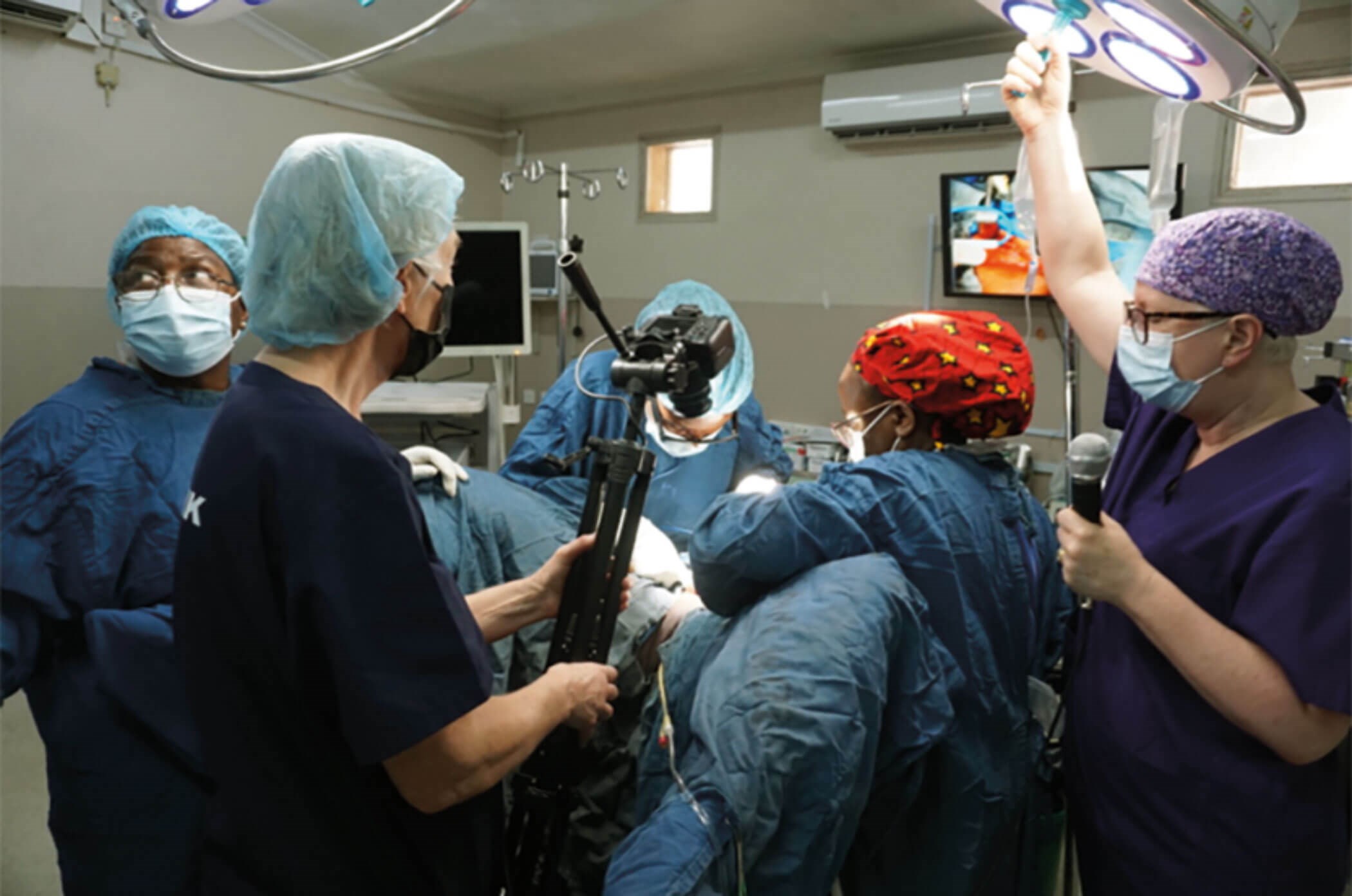

Existing evidence demonstrates the bidirectional benefits of trainees joining these visits [2,3]. Recognising this value, The Urology Foundation (TUF) Urolink Fellowship was established in 2021 to facilitate cross-fertilisation of skills and knowledge to enhance care provision for predominant local urological problems, whilst enhancing both host and visiting doctors’ professional development [4]. TUF is the only UK charity dedicated to tackling all urological diseases, advancing patient care through research, awareness and training initiatives.
To mark five years of TUF Urolink Fellowships in 2026, a survey was conducted to capture the experiences of previous fellows. This article shares those experiences, provides insight into the impact of the fellowship programme and considerations for those interested in participating in the future.
TUF fellow – what is it?
Every year TUF awards up to four grants to senior trainees (either in national training or locally employed doctors of registrar grade), all of whom must be BAUS members, and apply through an application found on the TUF website, alongside a letter of support highlighting their reasons for wanting to join a visit. Applications typically close at the end of May each year.
Applicants are not expected to know which visit they wish to attend, nor declare their sub-specialty interest module or be of independent operating level. The application provides an opportunity to explore their interest in urology global health work and what they hope to achieve by attending, helping to set expectations and align values. Successful applicants receive a maximum £1500 grant and join a visit of their choice via Urolink or independently organised with support from Urolink.
Urolink STSMs are not exclusive to TUF fellows, with non-TUF fellows sometimes joining either by self-funding or finding alternative funding. Visits typically last one to two weeks and can often utilise study leave.
Role overview
The TUF Fellowship recipients are announced at the Urolink session during the BAUS Annual Scientific Meeting. Given that the grant must be used within one year, fellows are promptly contacted regarding available visits or to confirm independently organised plans.
Varying members form the team, often consisting of 2–3 Consultants and 1–2 TUF fellows, or with a non-TUF fellow registrar. Before the visit virtual meetings with the host team are essential, with case-based discussions to identify patients, necessary pre-workshop investigations, formulating a timetable and understanding each other’s needs. Fellows support administratively, sometimes with equipment, and usually liaising with host resident doctors to prepare and deliver teaching.
A huge amount of preparation goes on behind each visit, though a recurring theme reported is the need to be flexible – from changes to patient plans once reviewed in person, a surprising bank holiday thus losing a day of workshop, or power cuts in theatres meaning teams are in pitch black using torches and operating in 40°C without air-conditioning.
Nonetheless, fellows diligently persist with their tasks which mainly involve teaching and supporting operating/procedures. Consultant led workshops may provide opportunities, with supervision, for fellows to support or lead on operative teaching. Previous workshops have included endoscopic urological procedures such as transurethral resection of prostate (TURP) and percutaneous nephrolithotomy (PCNL), urethroplasty and urogynaecological reconstructive surgeries, with fellows contributing depending on experience and case complexity [5].
One core role that is consistent throughout visits, is that fellows teach, often to medical students, resident doctors and sometimes consultants, through a mixture of lectures (with or without formal presentations), small group sessions or case-based discussions.
Although medicine is often practised in English, the local languages vary and learning styles are typically more didactic than in the UK. Building relationships and encouraging interactive learning can take time, but data demonstrates improved confidence in topics despite differing teaching styles [6].
Non-operative teaching may seem less exciting than assisting a clam cystoplasty, but fellows have found huge reward through it. After delivering a session, one fellow reflected that what stayed with them “was not the content itself, but the attitude in the room. There was a genuine enthusiasm to learn and to improve patient care, even in the face of significant constraints. It was a reminder that high-quality education does not depend on technology or perfect systems. That moment captured what the fellowship is really about: stepping outside your usual environment and realising that impact often comes from simplicity, adaptability, and connection rather than complexity.”
Past fellows advise contacting host residents in advance to plan which subjects to teach, spend time preparing sessions ahead of the trip – which frees up time for more clinical observing – and bringing additional copies of Oxford handbooks.
During the visit, fellows are exposed to unfamiliar pathologies and procedures, often disease at a more advanced stage than usually seen in the UK, all within the constraints of a resource-limited environment. There are often opportunities to observe and sometimes assist on surgeries, however, more time is usually spent teaching.
One fellow reflected, “you must park your UK mindset at the door – be prepared to feel unsettled.” Others described the need to adapt to different cultures, resources and healthcare systems, whilst also transitioning from a hands-on clinical practitioner to an observer/educator; temporarily one can easily “lose a sense of identity.” It is therefore important, to speak to previous fellows and their workshop consultants to help set expectations.
Programme impact
All fellows report a bi-directional benefit in joining a visit; from learning the topics they teach, to seeing new pathologies and thinking outside the box when they don’t have the ‘normal’ equipment e.g. the c-arm breaks, no second guidewire or single planar US for prostate biopsies. Attending visits make for better surgeons and decision makers with fellows feeling more confident managing conditions because “if it could be managed in a resource-scarce situation, it could be managed in the UK.”
Similarly, it is reported that on return to the UK, fellows are more conscious of the equipment they use, the investigations they request (distinguishing between what are truly valuable investigations and which are ‘nice-to-have’) and, although cliché, the gratitude they have towards training and access to healthcare.
It is a stark, humbling reminder of the privilege of training in the UK when seeing eight urology residents allocated to one TURP or consultants climbing on stools to observe parts of a colposuspension. All in the context that residents go through a highly competitive selection process, may practise for years in general medicine prior to applying for specialty training, and in some cases their specialty is assigned by their hospital or government sponsor.
Much can be learnt from observing the host faculty; from their excellent open surgical skills, ability to adapt intra-operatively to unexpected findings and exposure to how they manage advanced disease. Likewise, it is refreshing to witness the can-do attitude and gratitude for what (often little) they have, compared to the grumbling and perceived red-tape experienced when working within the NHS.
Unexpected benefits have included gaining teaching and leadership experience needed for certificate of completion of training, exposure to unfamiliar non-urological conditions and expanding networks both internationally and within the UK.
The TUF fellow survey identified that workshops also influenced future career aspirations, with some reporting increased interest in pursuing the same sub-specialty they taught. Although situations can be unfamiliar at times, fellows have declared an ongoing desire to be involved with global health work through online webinars, joining further visits or continued work with both Urolink and TUF.
Considerations
Joining an overseas visit can seem daunting, with many registrars interested but anxious to apply. Despite the unfamiliarity of urology in LMICs, the benefits far outweigh the challenges with three reflections repeatedly identified:
- Contribute with confidence
Visits often instil a sense of imposter syndrome, but workshops are not limited to senior registrars, specific workshop expertise or level of surgical independence. From delivering lectures, to supporting consultants in the operating theatre or simply keeping organised amongst constant changes, the aim of the programme is for fellows to gain experience. - Bidirectional benefit
The benefits to both host and visiting teams can be remarkable, even tangible after a single STSM. The sharing of knowledge, overcoming clinical and non-clinical challenges, and exposure to perspective-altering experiences have long-term impact on clinical practice. TUF fellows unanimously share how their practice will change, how these visits encourage them to become better decision makers and increases awareness of resource usage. - Not what you expected
The fellow’s role is different from an average day of a UK trainee. A recurrent theme is that despite all the planning, things frequently change. Learning to embrace the unpredictability, leaning on the host team and stepping out of one’s comfort zone is often a humbling yet rewarding experience.
Final friendly fellow advice
We hope this article has showcased urology experiences in LMICs and fuelled a desire to get involved. If so, here’s some advice from previous fellows:
- Read reports from previous fellows – some include practical advice about visits to specific hospitals.
- Visit the Urolink page on the BAUS and TUF websites – gain insight into ongoing work, including a full breakdown of survey results.
- Read around global urology – The British Journal of Urology International have a free-to-access series which would be helpful prior to any trip [7].
- Talk to previous TUF fellows – there is only so much an article can explain.
- Be flexible.
- Keep annual leave as the visit can be extremely tiring. Seize the opportunity to unwind after if possible.
- If travelling abroad is not for you, there are still ways to get involved in global health work, like donating expired equipment through a visiting fellow or charities like the Meditech Trust [8].
Lastly, we wish to express our gratitude to TUF, without whom joining a STSM would not have been possible for many. The fellowship has created access into not just overseas visits, but a gateway into long-term global health partnerships and changed clinical practice.
References
1. About Urolink. The British Association of Urological Surgeons.
www.baus.org.uk/professionals
/urolink/about_urolink_2017.aspx
2. Venn S, Mabedi C, Ngowi BN, et al. Disseminating surgical experience for sustainable benefits: the Urolink experience. BJU Int 2022;129(6):661–7.
3. Ng M, Chamileke N, Mapulanga V, et al. The benefits of virtual learning webinars to both low- and high-income countries. BJU Int 2022;129(4):434–41.
4. TUF Urolink Fellowships. The Urology Foundation.
www.theurologyfoundation.org/research-and-training/
apply-for-a-grant/research-grants/tuf-urolink-fellowships
5. About Urolink: Visit details and reports. The British Association of Urological Surgeons.
www.baus.org.uk/professionals/urolink/visit_details_2017.aspx
6. Leung LY. Urogynaecology Workshop – KCMC, Tanzania. The British Association of Urological Surgeons 2026.
www.baus.org.uk/_userfiles/pages/files/urolink/
Urogynaecology%20workshop%20April%202026.pdf
7. Payne S. Urolink: 20 years on. BJUI 2022;129(1)–130(6).
https://bjui-journals.onlinelibrary.wiley.com/
journal/1464410x/urolink-vi
8. How to donate. Meditech Trust.
https://medigive.org.uk/how-to-donate-individuals
[All links last accessed May–June 2026].