Case scenario
A 64-year-old woman with recurrent urinary tract infections and left flank pain undergoes investigations as an outpatient.
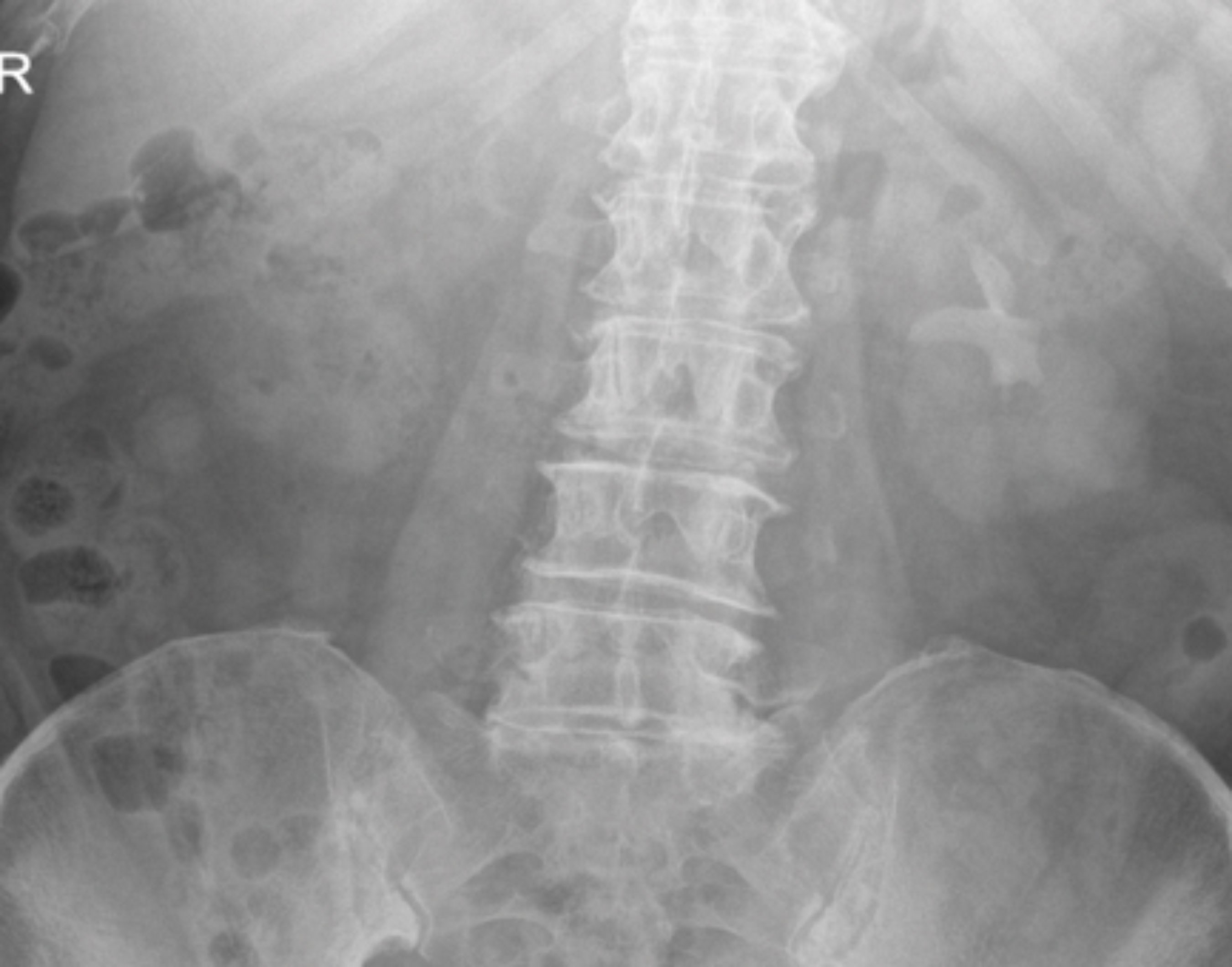
Figure 1a.
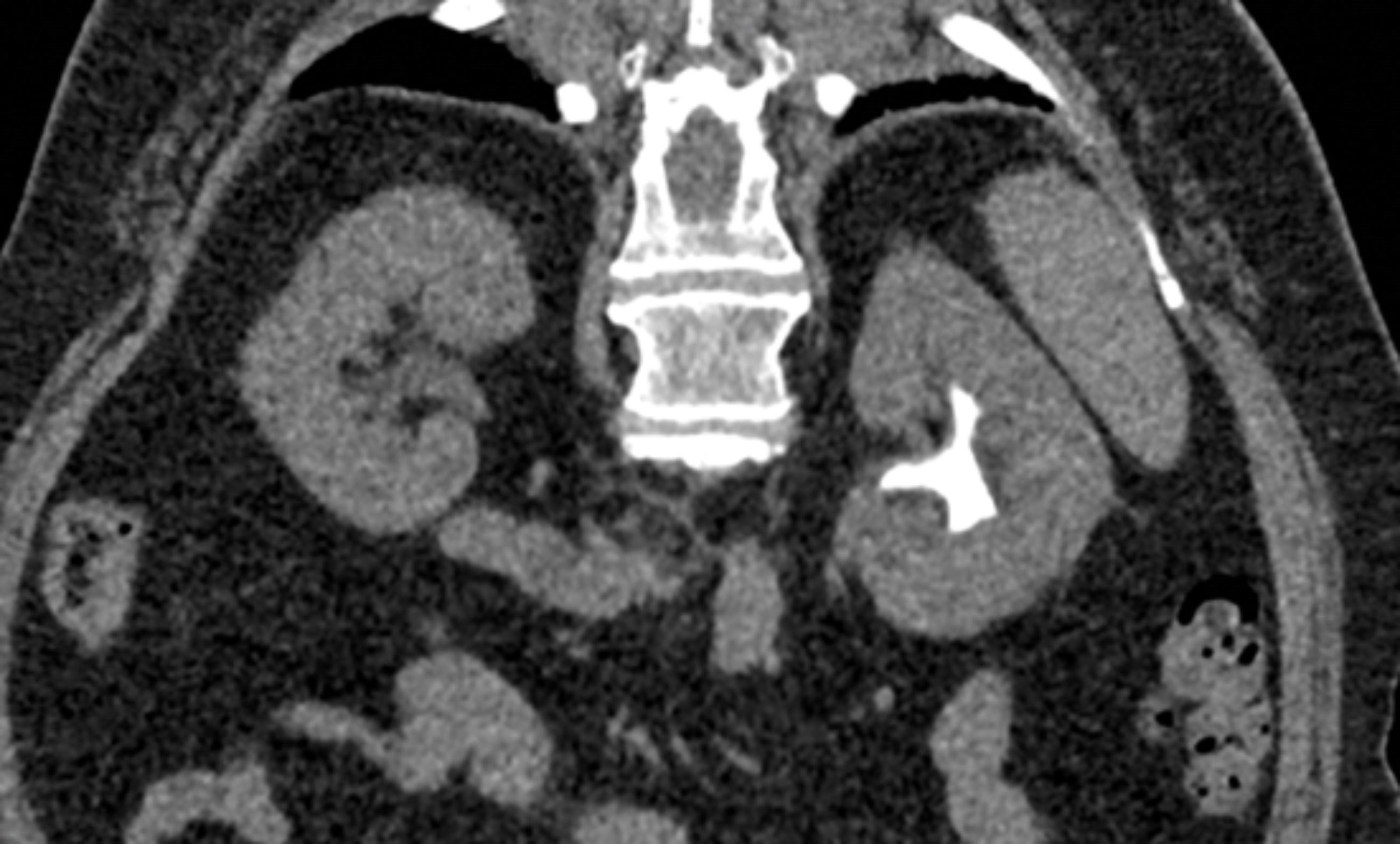
Figure 1b.
1. Describe Figures 1a and 1b.
2. Her co-morbidities are type 2 diabetes (which is well controlled) and hypertension – she is otherwise independent with a WHO performance status of 1. She asks if her stone can be managed conservatively; how would you counsel this lady?
3. Her pre-operative urine culture grows proteus mirablis.
What is the likely composition of her stone and how does it form?
4. She undergoes a percutaneous nephrolithotomy (PCNL) and her stone is successfully cleared. In the immediate post-operative period, she develops shortness of breath and on review is tachypnoeic and tachycardic, with a drop in oxygen saturations and decreased breath sounds on the left side. Urgent imaging shows the following complication.
What does the following imaging show (Figure 2)?
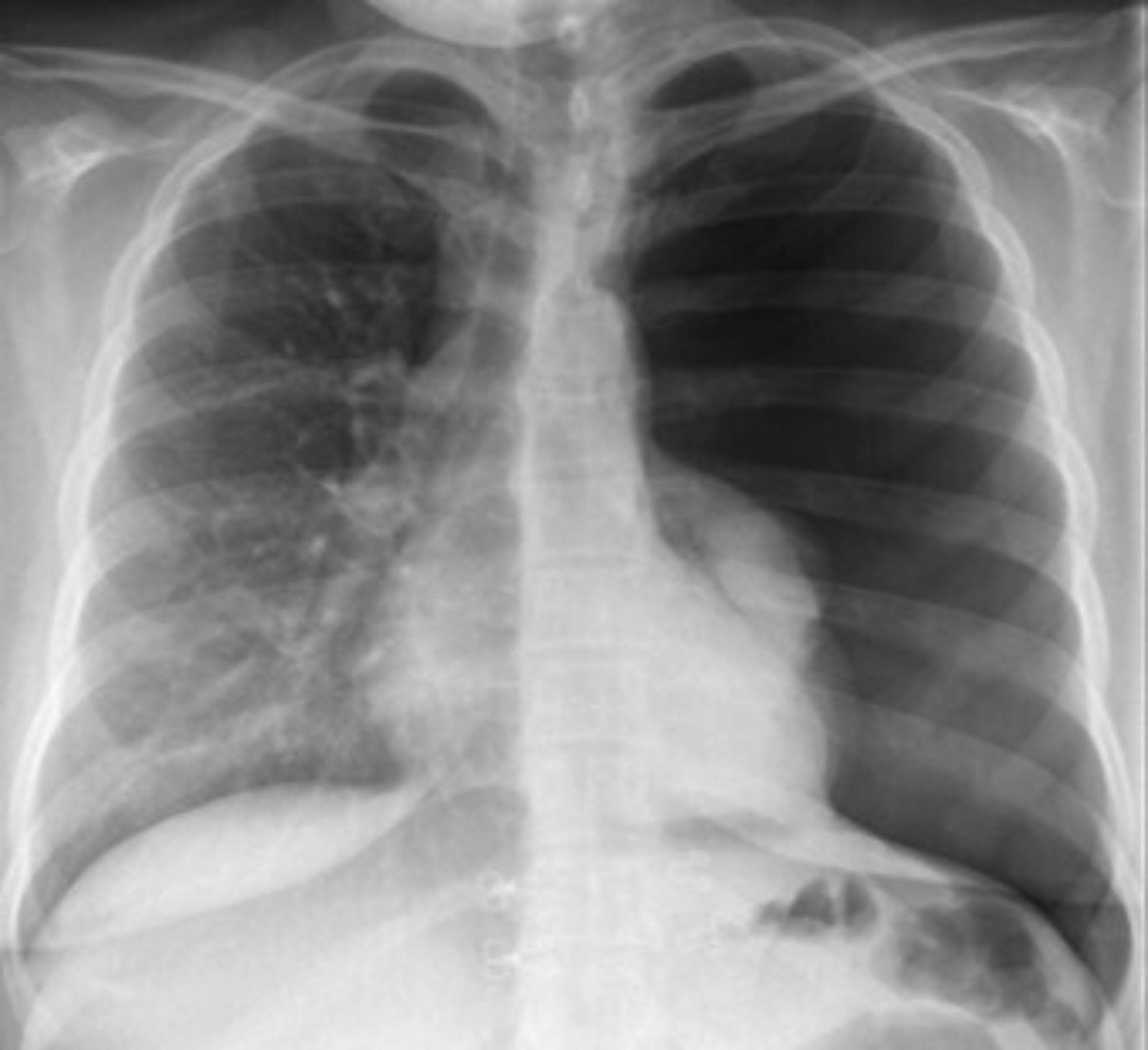
Figure 2.
5. What other major complications can be associated with PCNL?
Answers
1. Image 1a is a plain film x-ray KUB showing a large radio-opaque, branching stone filling the left renal pelvis and extending into the calyces, in keeping with a left staghorn calculus.
Image 1b is a coronal oblique reconstruction of an unenhanced low dose CT KUB of the same patient, showing the left staghorn calculus with no associated hydronephrosis or other signs of obstruction. Renal parenchymal thickness is preserved.
2. In 1976, Blandy and Singh published a seminal paper highlighting the high levels of morbidity and mortality in patients with staghorn calculi that were managed conservatively. Over 10 years, mortality rates were 28% vs 7.2% in conservative and operative groups, respectively with higher rates of sepsis and renal failure demonstrated in the conservative group, supporting a more aggressive surgical approach in patients with staghorn stones [1]. However, a recent systematic review has challenged this traditional dogma, concluding that in select patients with unilateral asymptomatic stones and minimal rates of infection, conservative management is not as unsafe as previously thought and could be considered [2].
Given this patient suffers from recurrent symptomatic infections and has a good performance status, current practice would be to offer active surgical management.
3. Struvite/Triple phosphate stones (magnesium ammonium phosphate). Proteus is a urease producing bacteria. This group of bacteria, which includes klebsiella and pseudomonas, produce the enzyme urease which breaks down urea within urine into ammonia and carbon dioxide, raising the urinary pH [3]. The subsequent alkaline environment helps promote precipitation of magnesium ammonium phosphate (struvite) or ‘infection’ stones.
Struvite stones require high urinary pH (>7.2) and a high ammonia concentration to precipitate. Staghorn stones are hence most commonly seen in association with infection with urea splitting organisms, of which proteus mirabilis is the most common. E Coli, however, remains the commonest organism found in association with renal stones (non-staghorn) [4].
4. Image 2 is a PA chest x-ray demonstrating absence of lung markings in the left hemithorax with a collapsed left lung around the left hilum and mild mediastinal shift to the right. These appearances are in keeping with a large pneumothorax.
5. Major complications associated with PCNL can be categorised as follows:
- Associated organ injury such as diaphragm/pleural violation (more common with upper pole percutaneous access) resulting in hydrothorax or haemothorax as well as pneumothorax. Injury to solid organs including the spleen and liver, hollow viscera/bowel or the great vessels can occur.
- Bleeding; acute haemorrhage due to injury to the great vessels or main renal vessels is rare (<0.5%) and most commonly occurs during initial percutaneous access. Transfusion rates have fallen significantly over time to as low as 2%. Embolisation or nephrectomy (<0.5%) may be necessary in severe cases.
- Sepsis; transient post-operative fevers occur in up to 30% of patients after PCNL, but sepsis rates are significantly lower, ranging from 0–3%.
- Renal collecting system injury can occur in up to 8% of patients undergoing PCNL, whilst obstruction is a rare complication that may result from residual stone, ureteric avulsion or stricture, mucosal oedema or blood clot [5].
References
1. Blandy J, Singh M. The case for a more aggressive approach to staghorn stones. J Urol 1976;115(5):505–6.
2. Alsawi M, Amer T, Mariappan M, et al. Conservative management of staghorn stones. Ann R Coll Surg Engl 2020;102(4):243–7.
3. Fitzgerald MJ, Pearson MM, Mobley HLT. Proteus mirabilis Urea coordinates cellular functions required for urease activity. J Bacteriol 2024;206(4):e0003124.
4. Coull N, Kouriefs C, Hodgson D, et al (Eds.). Postgraduate Urology: The Examinees Guide [eBook]. BsoT; Astellas 2016.
www.baus.org.uk/professionals/
bsot/frcs_ebook.aspx
[Accessed January 2026].
5. Taylor E, Miller J, Chi T, Stoller ML. Complications associated with percutaneous nephrolithotomy. Transl Androl Urol 2012;1(4):223–8.